
Alameda County Public Records Inventory
Alameda County public records are not held by one master office. The Clerk-Recorder keeps recorded documents and many county clerk services. The Assessor maintains property assessment and parcel records. The Superior Court controls court files by division. County agencies use a CPRA portal for ordinary county-operation records, while state offices keep statewide vital, license, business, prison, privacy, and registry systems.
| Record set | Custodian | Online index | Access |
|---|---|---|---|
| Official public records, deeds, liens, FBNs | Alameda County Clerk-Recorder | 1969-present electronic index | Online search for recent index; 1853-1968 in person or mail |
| Civil, family, probate, mental health, adoption cases | Alameda Superior Court | eCourt Public Portal | Registration required; documents vary by division |
| Criminal case information | Alameda Superior Court | Odyssey Portal | Free web case information for activity since 2005; no web documents |
| Parcel and assessment records | Alameda County Assessor | Property Search and Parcel Viewer | Free search by APN or address; maps also in person |
| Birth, death, marriage, divorce certificates | County Clerk-Recorder and CDPH | Application and request channels | Authorized or informational copy rules under California law |
| Voter registration data | Registrar of Voters and Secretary of State | Personal lookup, request form, voter-file application | Allowed purposes only; confidential voters excluded |
| Jail custody and state registries | Sheriff, CDCR, California DOJ registry | Inmate locator, CDCR locator, Megan's Law | Official lookup rules and warnings apply |
That inventory also shows the main public-records boundary. A portal can prove that a record type exists, but access may still depend on age, case type, eligibility, copy status, or whether a statute makes the information confidential.
Alameda CPRA Records Access
California's public-records law is the California Public Records Act, Government Code section 7920.000 et seq. The basic rule is that public records are open unless an exemption applies. Agencies generally must determine within 10 days whether they have disclosable records, and Government Code section 7922.535 permits a 14-day extension in unusual circumstances.
The CPRA is a request law, not a promise that every people record is public. Alameda County public records requests through NextRequest are for non-confidential county documents related to county operations. Normal purchasable records, such as vital certificates or recorded document copies, follow the office's purchase process instead of the county's CPRA queue.
The Alameda County NextRequest portal is the county's public request surface for agency records.
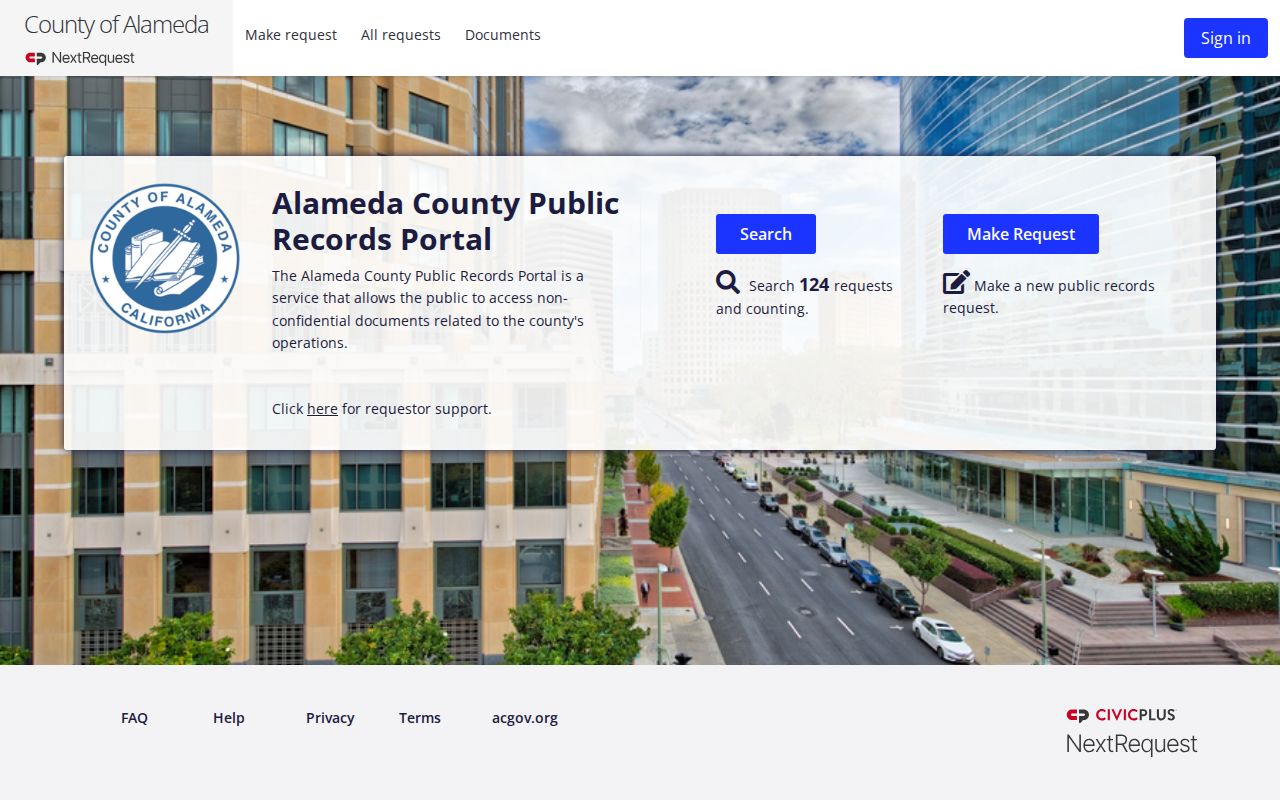
The portal image shows the search and make-request controls used when a record is not already available through a specialized office index.
Alameda County Records Portals
The public-records system works best when the request goes to the office that actually holds the record. The Clerk-Recorder can answer recorded-document and county clerk questions. The Assessor controls parcel and assessment data. The Superior Court is a separate state trial-court custodian. The Registrar of Voters handles election records and voter data. County departments use NextRequest for CPRA requests about agency operations.
Superior Court
Records divisions in Oakland, Hayward, Fremont, Dublin, Berkeley, and Alameda
AskRecordsManagement@alameda.courts.ca.gov
Alameda County Recorder Records
The Alameda County Clerk-Recorder is the core public-records office for deeds, liens, recorded documents, public record searches, fictitious business names, notary oath and bond filings, and related county clerk services. The county states that official public records date back to 1853 and can be found alphabetically by names of parties identified on documents. The web index begins in 1969. Pre-1969 records require in-person research, and copy requests for 1853-1968 records must be made by mail or in person.
Copy fees are specific. Plain copies are $3.50 per page. Certified copies are $4.50 for the first page and $3.50 for each additional page. In-person copy requests require a form with office staff; most are completed then, but large or high-page requests take one to three business days. Copy requests received after 4:00 p.m. are processed the next day, and printing stops at 4:15 p.m.
| Field or control | Type | What it does |
|---|---|---|
| Availability | Modal link | Explains the 1853 start, 1969 online search point, and two-week wait after filing |
| Copy Fees | Modal link | Lists plain and certified copy pricing |
| Instrument, book/page, reel/image question | Yes/no route | Separates known-record orders from research tasks |
| Online, By Mail, In Person | Route choice | Chooses the copy-order channel |
| Research online or in person | Route choice | Sends unknown-record searches to the web index or office counter |
Alameda Court Records by Division
The Superior Court of California, County of Alameda is not a county department, so court files have their own rules. Civil, family law, probate, mental health, and adoption records use eCourt Public Portal, where account registration is required for functions. Criminal case information uses Odyssey Portal for cases with activity since 2005. Odyssey web access does not include documents.
In-person terminals matter. The court says individuals may research court records at no cost using public access terminals and indexes, and files may be viewed only on the premises. Odyssey Kiosk public terminals at select court locations include access to public documents that web Odyssey does not include. For felony cases before 1974, the court directs users to a Criminal Division or the California Department of Justice.
Terminal tip. A failed web search does not prove a court record is absent. Older or document-level criminal access may require an Alameda court terminal.
Alameda County Assessor Records
Assessor public records connect names, addresses, parcels, and maps. The public Property Search uses three visible search choices: Parcel Number, Type Ahead Address, and Property Address. The Parcel Viewer and map pages help translate an address into a parcel boundary. Online parcel maps are free, while printed assessor maps cost $3.00 per 14 inch by 18 inch copy or $1.00 per 8.5 inch by 11 inch copy.
The Assessor also notes that the office has online maps and in-person map access. Written map-copy requests go to the Alameda County Assessor, 1221 Oak Street, Room 145, Oakland, CA 94612, Attention: Mapping Unit. A two-year property transfer list exists at the county data portal, which can help confirm recent transfer activity without treating the assessor site as a full deed index.
Alameda Vital Records Copies
Vital records are public records only in a limited sense. Alameda County Clerk-Recorder issues local birth, death, and marriage certificates, while CDPH Vital Records maintains statewide birth, death, fetal death or still birth, marriage, and divorce records. CDPH has no public counter and sends records by USPS First Class Mail.
Health and Safety Code section 103526 controls authorized and informational certified copies. An authorized certified copy can establish identity and requires the applicant to qualify and sign a sworn statement. An informational certified copy cannot establish identity. Confidential marriage records are not maintained by CDPH; they are available only from the county clerk where issued and only to the two parties.
The California Megan's Law registry is a different state public-record system, but its landing page shows how California attaches statutory warnings to sensitive public data.
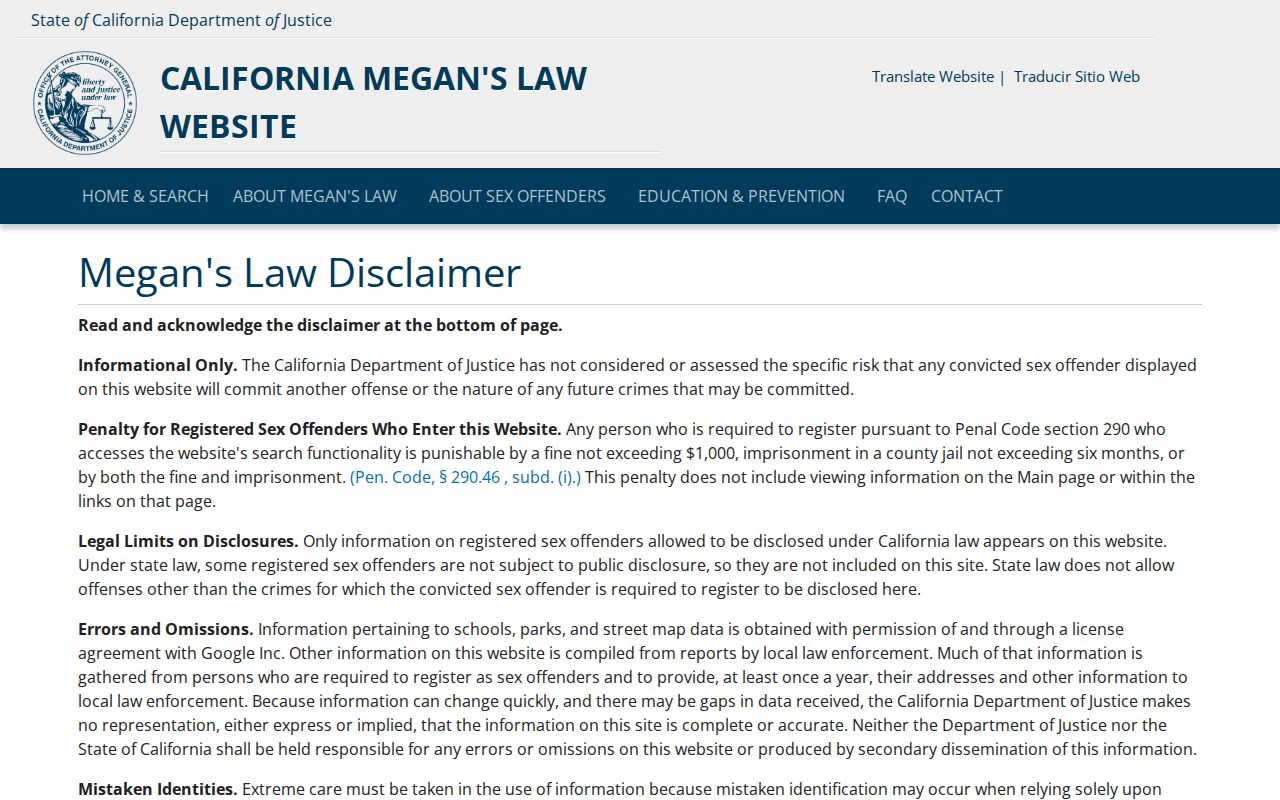
The registry image is a reminder that public access can come with legal limits, warnings, and case-specific restrictions.
Request Alameda County Public Records
Use the CPRA request path when the record is a non-confidential agency record and no specialized purchase or search process fits. The Auditor-Controller public records request page points requesters to NextRequest and warns that normal purchasable records, including vital records, are outside that request flow. Alameda County public records requests should name the agency, describe the record, and include the date range, office, subject, and format if known.
- Identify the custodian: Clerk-Recorder, Assessor, Superior Court, Registrar of Voters, Sheriff, city office, state agency, or county department.
- Check the custodian's online index, request page, or copy-order page before filing a general CPRA request.
- Submit the request through NextRequest or the office-specific form, mail route, or counter route.
- Pay only the copy, certification, map, data-compilation, or programming charge the office identifies.
- Narrow the request if the agency asks for clarification or cites an exemption.
The Auditor-Controller public records request page links the county's CPRA instructions to the portal.
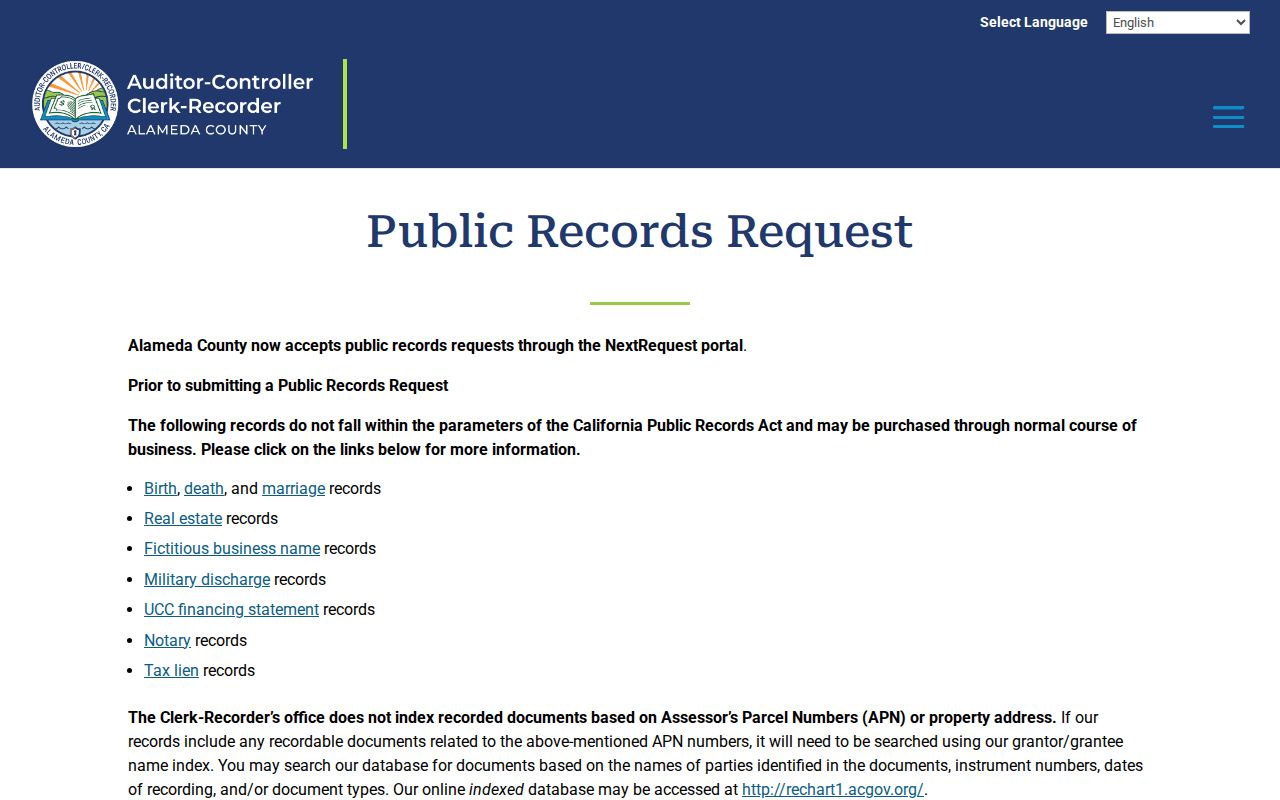
The screenshot shows the county's own distinction between public-records requests and ordinary office copy purchases.
Lawful use. Alameda County public records are open for lawful personal, family, property, civic, and safety research. Do not use them to stalk, harass, threaten, or harm anyone.
Alameda Business License Records
State business and license systems are part of the practical public-records map. The California Secretary of State bizfile Online searches corporations, LLCs, limited partnerships, and public filings. The Secretary of State search hub also links trademarks, certified-copy verification, and immigration consultant searches. Alameda County fictitious business name filings remain with the Clerk-Recorder, so a local trade name may require both state and county searches.
The Department of Consumer Affairs License Search verifies board-issued licenses and can show whether a license is current, expired, or subject to discipline. The State Bar search, CSLB contractor lookup, and county FBN records fill out the public-records trail for people tied to a professional or business name.
The bizfile Online search is the state business filing tool used for corporations, LLCs, and limited partnerships.
The state screenshot connects Alameda County searches to statewide business filings rather than low-quality name databases.
Closed Alameda County Records
Some records stay closed or restricted even when the related office is public. Juvenile records require a petition under Welfare and Institutions Code section 827 on Judicial Council form JV-570. Adoption records are confidential and accessible by court order only. Conservatorship, guardianship, confidential probate documents, sealed court files, and other protected matters may not appear online or may be redacted.
Voter records are also limited. Public voter-registration information is controlled by Elections Code sections 2183 through 2188, while confidential voter statutes exclude protected voters. Safe at Home can substitute addresses for qualifying participants. DMV data is protected by the federal Driver's Privacy Protection Act and is not a public people-search source.
| Index | A searchable pointer to a record, often showing names, dates, case numbers, or document identifiers. |
|---|---|
| Image | The scanned document itself, which may require payment, registration, office review, or in-person access. |
| Certified copy | An official copy issued by the custodian, often with a seal or certification fee. |
| Custodian | The agency, court, or office that controls the record and decides access under law. |
| Exemption | A legal reason an agency may withhold or redact a record. |
Alameda Records Access Gaps
The largest Alameda County public records gap is not a missing record set. It is the divide between online and non-online access. Recorder records before 1969 require in-person or mail handling. Criminal web records cover cases with activity since 2005, while in-person information reaches many cases opened since 1974. Probate images are available for documents filed after January 31, 2006 except restricted categories. Older felony matters may require Criminal Division assistance or the state Department of Justice.
Historical records add a second route. The California State Archives lists Alameda County marriage records from 1854-1955 on microfilm. Local libraries hold city directories, reverse directories, phone books, yearbooks, and newspapers that may identify people when a modern record is closed, not digitized, or too new to release. Those sources are public-record-adjacent, but they can be the most useful route for family history and older address research.