
Alameda County Voter Registration Lookup
Alameda County voters have two status-check routes. The statewide California Secretary of State My Voter Status tool is the direct personal lookup. The county also points voters to the AC Vote voter profile through the Alameda County Registrar of Voters. These tools help a voter check registration, party preference, language preference, vote-by-mail or provisional ballot status, polling place, sample ballot, and election contact details.
The lookup is not a browse-all-voters search. It is built for the voter whose record is being checked. That distinction matters in Alameda County records because the public voter file is a separate product with eligibility rules, fees, and confidentiality exclusions.
| Lookup field | Input type | Required | How the captured tool uses it |
|---|---|---|---|
| First name | Text | Yes | Personal information section on My Voter Status. |
| Last name | Text | Yes | Paired with birth date to find the voter's own record. |
| Date of birth | Month, day, and year | Yes | The screen shows separate month, day, and year inputs. |
| Language preference | Page option | No | The page offers English, Spanish, Chinese, Hindi, Japanese, Khmer, Korean, Tagalog, Thai, and Vietnamese. |
The official screenshot from My Voter Status shows the personal information fields and the kinds of status items the state tool can return.
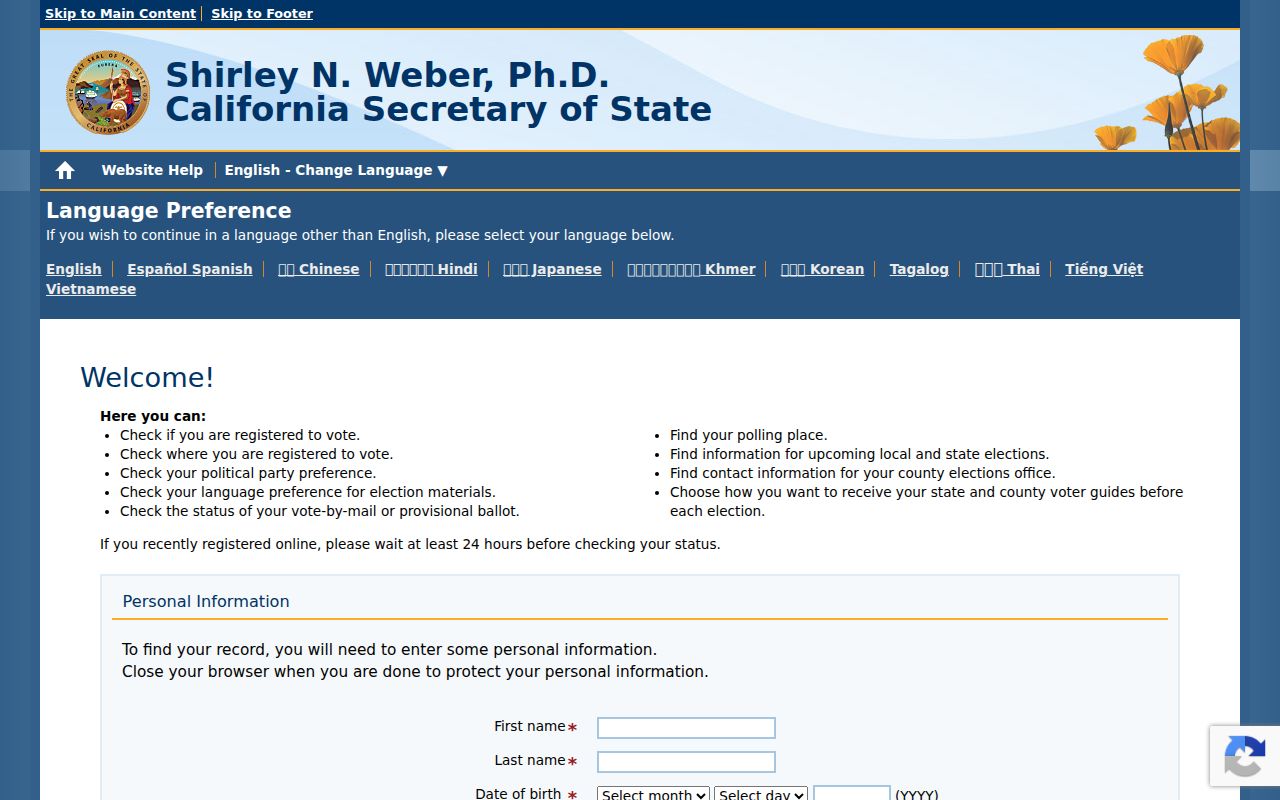
Use that screen for personal confirmation first. If the question is broader than one voter's own status, the request belongs with the Registrar of Voters or the Secretary of State voter file process.
My Voter Status Is Personal
The most common Alameda County voter-record mistake is treating My Voter Status like a public people directory. It is not one. The tool lets a voter check where they are registered, whether their party preference or language preference is on file, and how their ballot or polling details are set for an election. It can also help a voter find contact information for the county elections office.
Public voter rolls follow a different route because California law limits who may receive registration information and for what purpose. Alameda County election staff may maintain the local records, but the public data rules come from state election law and the Secretary of State file-request process.
Do not merge the tools. My Voter Status is a personal status check; the voter file is a controlled records request.
What California Voter Records Show
California voter records can identify a registered voter, but the release is not the same as a public web profile. The record may include name, residence address, mailing address when supplied, county of residence, party preference, registration status, registration date or record date, precinct and district assignments, and voter history when requested and authorized. Voter history means participation history, not ballot choices.
Fields that create identity risk are withheld from public release. Social Security numbers, driver's license or state ID data, signatures, and confidential protected-voter information are not released as ordinary voter records. Alameda County file data also excludes confidential voters from authorized-requester files.
| Voter name | May appear in an authorized file or specific voter-record request. |
|---|---|
| Residence or mailing address | May appear unless the voter has confidential status or another protection applies. |
| Party preference | May be included because California registration records capture party preference or no party preference. |
| Status | Active, inactive, cancelled, or a similar registration status may appear depending on the product. |
| Vote history | Shows elections in which the voter participated when authorized; it does not show votes cast. |
| Protected data | SSN, ID numbers, signatures, and confidential voter information are withheld. |
Confidential by law. California Elections Code sections 2166, 2166.5, 2166.7, and 2166.8 exclude confidential voter records from release. Section 2166.9 adds special limits for confidential contact information tied to certain elected officials and candidates.
Alameda County Confidential Voter Rules
California privacy rules matter more for voter records than for many other public records. The Secretary of State voter file page states that some confidential records are not provided to any requester. That exclusion applies even when the person asking for data is otherwise authorized to receive voter information.
The Safe at Home program is the state address confidentiality program. It provides a substitute mailing address and can help shield a real residential address in voter and other public records. In Alameda County, that means a missing or substituted address may be a legal protection, not a data error.
Note: Protected voter records should be treated as closed unless the election office or state law says otherwise.
Request California Voter File
The statewide voter file is handled through the Secretary of State voter file request. California allows registration information, with exceptions, to candidates for office, certain ballot-measure committees, people using it for election, scholarly, journalistic, or political purposes, and people using it for governmental purposes as determined by the Secretary of State. Requests may be made to the Secretary of State or to a specific county.
The Secretary of State application distinguishes between a statewide file and specific voter records. A statewide file can cover all California voters and may include voter history or political district data when requested and authorized. A single-voter request can cover up to ten voters per application and requires full name, date of birth, county of residence, and residence address for each voter.
| Request path | Who handles it | Required details | Fee stated in research |
|---|---|---|---|
| Statewide voter file | California Secretary of State | Requester qualification, purpose, and file options | $100 application fee |
| Specific voter record | Secretary of State or county | Full name, birth date, county, and residence address for each voter | $30 per record, up to $100 |
| County ROV records | Alameda County Registrar of Voters | Enough detail to identify the record, plus contact and response information | No charge for staff time; copy or data work charges may apply |
- Choose the right channel. Use My Voter Status for personal registration status, the Secretary of State file process for voter-file data, or the county ROV form for records held by the Alameda office.
- State the allowed purpose. The voter file request requires an election, scholarly, journalistic, political, or governmental purpose, or one of the listed candidate or committee categories.
- Provide the identifying fields. For specific voter records, include the full name, date of birth, county of residence, and residence address for each person.
- Pay the stated fee when the file process requires it. County public-record charges may differ when paper copies or data compilation are involved.
The Secretary of State voter file application is the formal state document. Alameda County voter records sit inside that statewide framework when the request is for file data rather than a one-person status lookup.
Alameda County ROV Request Form
The Alameda County Registrar of Voters public-record request form is the local CPRA channel for records maintained by the ROV. It asks for requester contact details, a request description, a preferred response method, and an election name or date when relevant. The form says records are available under the California Public Records Act, but a record may be withheld when an exemption applies.
The form also states the fee principle for local election records. Alameda County does not charge for time and effort spent finding or collecting records, but it may charge for photocopying paper records and for data compilation, extraction, or programming when the law allows it. For broader records-law context, the county's general request process is covered on the Alameda County public records page.
| Form field | Required | Purpose |
|---|---|---|
| First name, last name, street address, city, state, ZIP | Yes | Requester contact and mailing information. |
| Email, confirm email, phone number | Yes | Response and follow-up contact. |
| Organization | No | Optional requester context. |
| Request description | Yes | Record details, as specific as possible. |
| Preferred response method | No | Electronic or hard copy. |
| Election name and date | No | Useful when the request concerns a specific election. |
The county capture of the ROV public-record request form shows the local path for election records that are not solved by a personal status lookup.
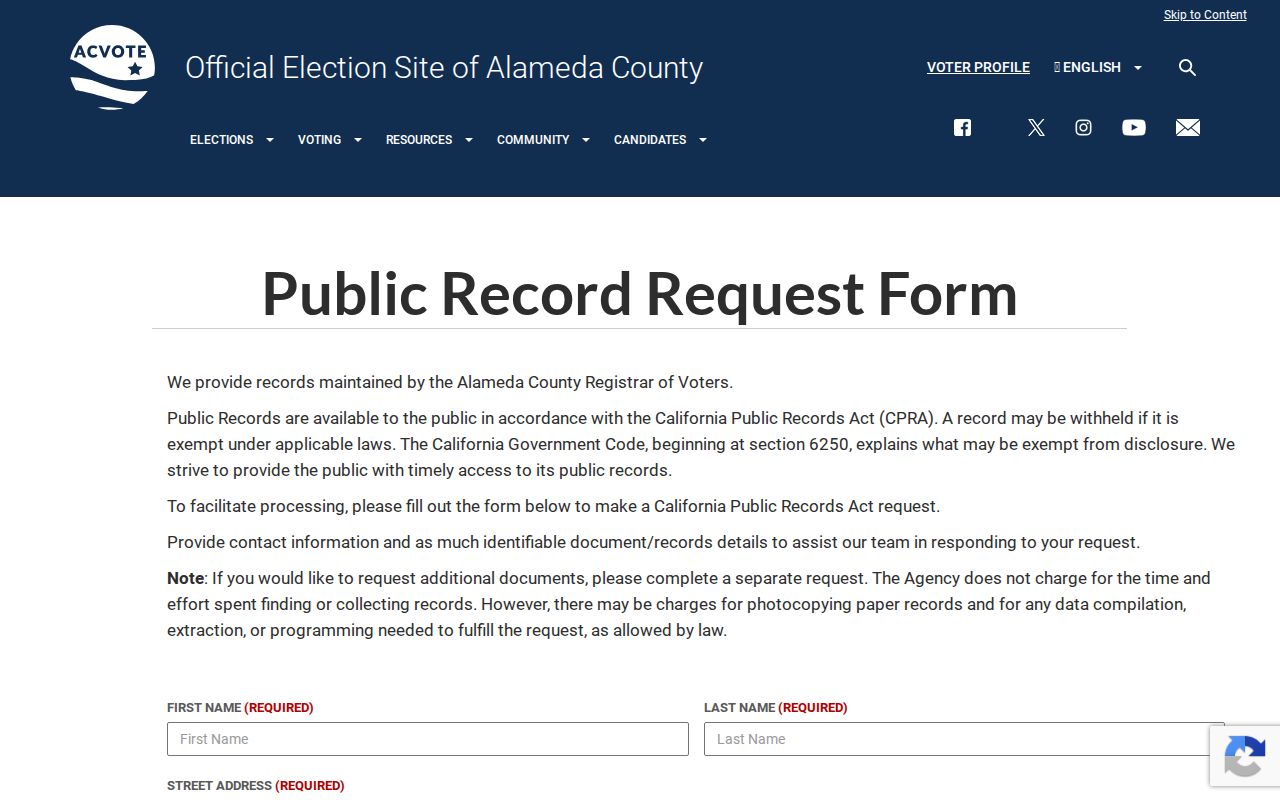
That form is useful when the request is about Alameda County election records, published notices, candidate lists, or other ROV-held material rather than the statewide voter file product.
Alameda County Voter Data Store
The Registrar also maintains an online store for election and voter data downloads. The Alameda County ROV store is separate from the public-record request form. It is the county's ordering path for election data products when the product is available through the store rather than by a custom records request.
Use the store for posted data products and the ROV public-record form for a tailored records request. Use the Secretary of State voter file application when the requested file is the statewide voter file or specific voter records controlled through the state application process.
The ROV store screenshot in the manifest captures the county download storefront for voter and election data.
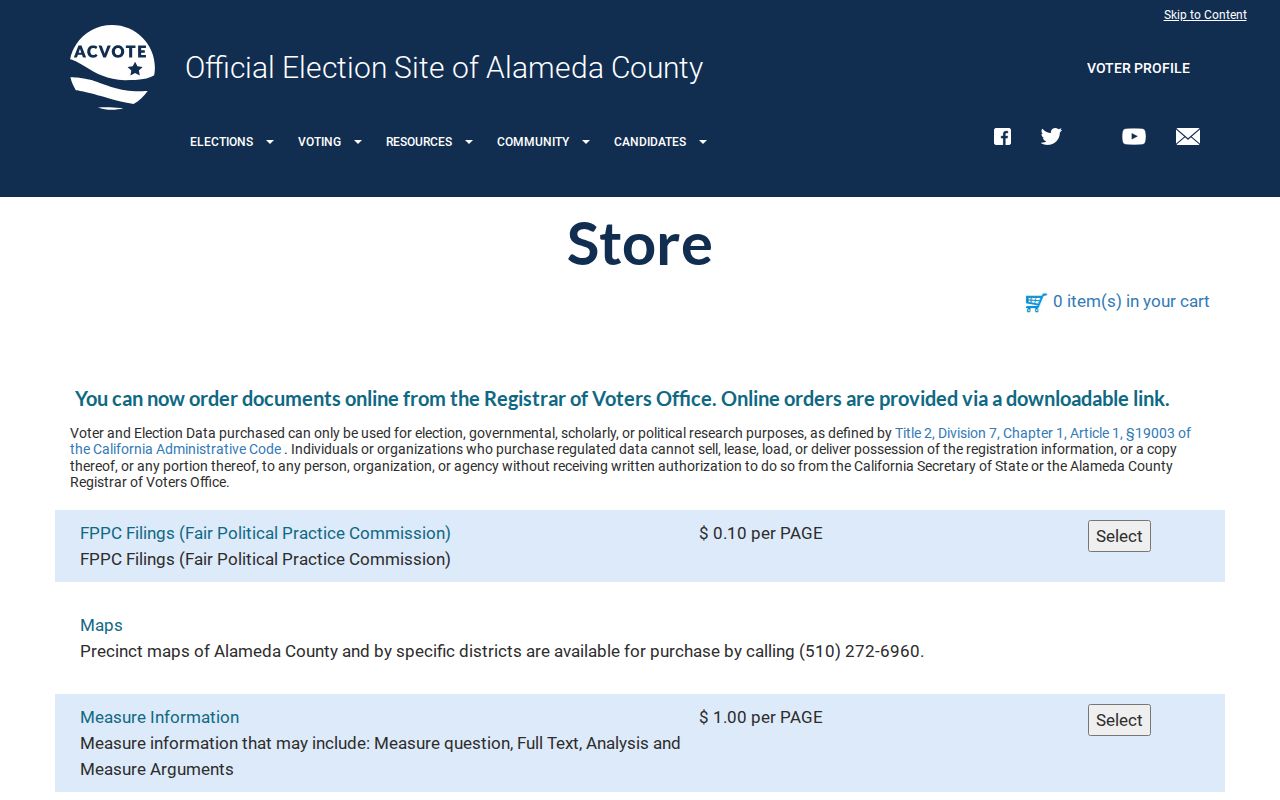
The key practical split is simple: status check, store order, public-record request, and voter-file application are four different routes.
Alameda County Voter Roll Numbers
The county's election data dashboard gives a public view of Alameda County registration and election data without releasing the controlled voter file. The inspected screen showed 973,599 registered voters, 428,681 vote-by-mail records, a Public Record Request tile, and 49 viewable maps. Those numbers support civic and research context, but they are not a name-by-name voter directory.
This is the best public numbers layer for Alameda County voter records. It helps show scale, district geography, and historical election context while keeping confidential voter rules intact. It also points users back to the ROV public-record request channel when the dashboard does not contain the needed record.
The manifest image from the Alameda County elections data dashboard shows the public statistics and map interface.
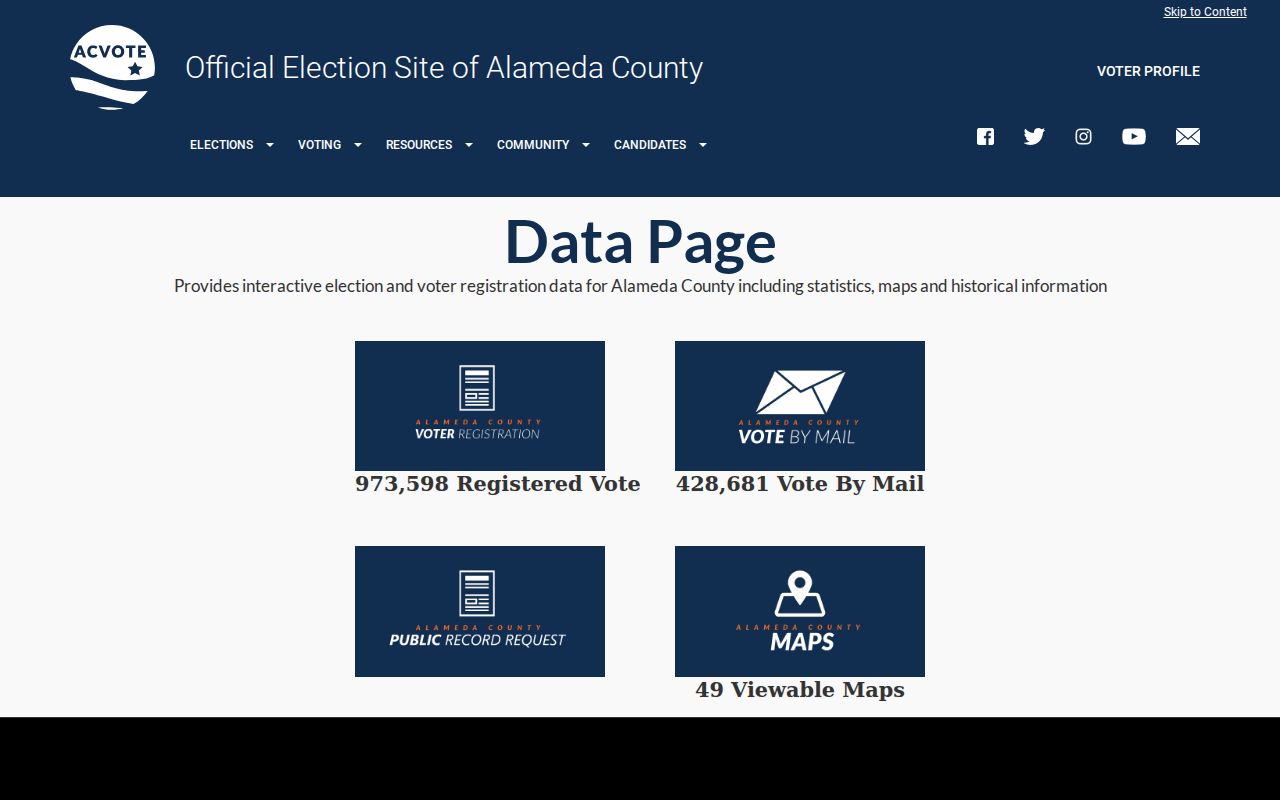
Numbers and maps can answer many election-data questions before a formal request is needed.
Alameda County Voter Data Limits
Voter file information cannot be treated as a general-purpose contact list. California's rules limit release to qualified requesters and allowed purposes, and confidential voters are excluded. Research into Alameda County voter rolls should stay within election, scholarly, journalistic, political, governmental, genealogy, civic, or other lawful personal-use boundaries supported by the official process.
Misuse can trigger penalties under election law. The practical rule is to verify the request path before collecting the data, keep the stated purpose narrow, and do not use voter data to harass, threaten, or target a person. If a record appears incomplete because an address or contact field is missing, treat that absence as a possible legal protection.
Use restrictions apply. Alameda County voter data is available only through authorized channels and purposes; protected voters and confidential fields stay outside the release.
Historical Voter Records in Alameda County
Historical voter research is different from current Alameda County voter records. The California State Archives says county records can include Great Registers, a historical form of voter roll. The inspected sources did not locate an official Alameda County Great Register year range, so the safer historical route is to treat Great Registers as a state-level record type and pair them with library and genealogy sources.
The California State Archives county and city records inventory is the first archival lead. Alameda County libraries and genealogy institutions can fill gaps with city directories, telephone books, newspapers, yearbooks, and local-history files. Those sources do not replace a current voter file, but they can place an earlier resident in Oakland, Berkeley, Alameda, or another East Bay community when modern web records stop.
Note: No official Alameda County Great Register date span was found in the inspected research sources.